







![Assistant Athletic Director of Academic Retention & Services Jill Gerloff delivers the opening speech at her final NGWSD dinner before her retirement. “I love all of my athletes and my women's teams always show up for me, and I want to make sure that I can do something to show up for them,” Gerloff said. [File photo]](https://therambler.org/wp-content/uploads/2026/02/OpeningSpeaker_Gerloff-1200x800.jpg)












Around midnight, Mysti Wolfe cracks her laptop open. After a long day of negotiating with insurance companies and caring for five children, she begins working on her own assignments during the only hours she gets to herself.
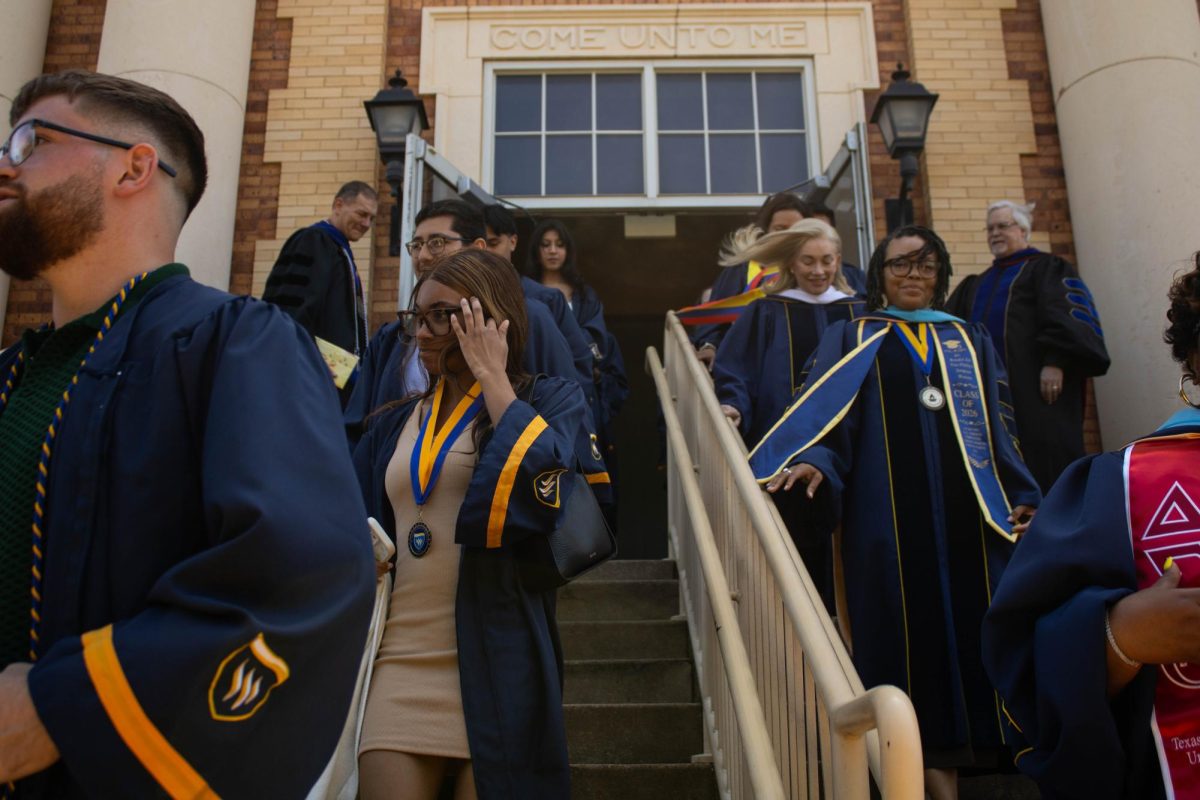
Wolfe, a junior political science student, is one of several non-traditional students at Texas Wesleyan balancing careers, families and leadership roles with coursework. For students like Wolfe, college is not a transition into adulthood, but an added layer upon a life already in motion.
Non-traditional students are often defined as those over 24, working full time, parenting, or returning after time away from school, according to the National Center for Education Statistics. These students became a growing number of enrollments nationwide following the COVID-19 pandemic, as they sought ways to overcome economic hardship.
Oftentimes for non-traditional students, choosing to return to college is no accident. Returning at a later stage of life is a decision shaped by experience, responsibility and purpose.
Rosemary Adio is a mother of two double majoring in religion and psychology in her 30s. Although financial obstacles and family duties delayed her educational goals, her return to school reignited a passion for learning.
“My journey has not been smooth,” Adio said. “The curiosity in me has given me the courage to be able to withstand the challenges of being older and being in school.”
Non-traditional students like Adio come from diverse backgrounds, with experience in a variety of fields. Their unique perspectives often seep into the classroom, reshaping class discussions in ways that younger students may not expect.
Wolfe, a political science major and aspiring attorney, described how years as a paralegal have changed the way she approaches conversations in class.
“There’s a definite difference that most people don’t learn from school that you get with real life experience,” Wolfe said. “You can only be taught so much in a book.”
Frederick Poeggel, a 57-year-old religion and history major, echoed that feeling. After serving seven years in the U.S. Army and retiring from government work, he shared that returning to school has allowed him to connect coursework to decades of lived experience.
“I’ve already been out in the world,” Poeggel said. “I’ve already seen more than a lot of people, so now I can just focus on what God wants me to do.”
Poeggel shared how he has been able to piece together experiences from his adolescence to lessons in his civil rights class.
“I’ve been around the world; I’ve seen a lot of things,” Poeggel said. “Now I can kind of put them together; now it’s like, Oh, wow, that’s what Granny was saying, you know?”
In classrooms where students are navigating a new independence for the first time, non-traditional students’ perspectives may differ in what feels urgent and worth pursuing.
Having already lived through various chapters of life, time feels different to these students.
For Jennifer Redmon, a 47-year-old criminal justice major, this is reality faced daily. Her coursework is squeezed between full-time shifts at a closed-door pharmacy and the responsibilities of adulthood.
“If you fall behind, you’re not going to get caught up,” Redmon said, explaining that she often studies in small windows of time before or between her duties.
But discipline does not eliminate hardship for non-traditional students. “Just because we are older doesn’t mean we don’t stress or struggle the way [traditional students] do,” Redmon said.
For some, the cost of making their dreams reality is exhaustion.
Wolfe shared the feeling of pressure, describing the need for “a 28-hour day” to balance five children, a full-time legal career and political science coursework. “I have a lot of have-to-do before I get to the want-to-do,” she said, “and school falls under something I’m doing because I want to.”
Even Poeggel, who is now retired, understands how quickly time can pass. “I’ve got four papers due before the end of April, and I’ve already got three of them halfway done,” he said.
The influence of non-traditional students extends beyond their personal discipline. Their presence reshapes the tone of classroom discussions and the sense of community on campus.
For Adio, her impact begins with connection. Her African roots, motherhood and leadership roles have cultivated her ability to intentionally build connection and community anywhere she goes.
“When I ask you how you’re doing, I really want to know,” Adio said. “I don’t wait for people to say hi, I go ahead and acknowledge that you’ve been seen.”
Around campus, she greets classmates by name and often checks in to ensure they are feeling supported.
In classrooms where students may still be building their confidence and foundations, Adio said that these gestures of acknowledgement can shift the atmosphere entirely.
Other students echoed the desire to provide guidance to their younger peers.
“I’m here for anybody who’s out there,” Poeggel said. “I might not have the right answer, but I could help [them] figure it out.”
Redmon shared that her motherly instinct sometimes shines through her desire to guide her peers. “I kind of want to take over as a parent, helping them, guide them in the right way.”
Unlike students following a traditional timeline, these students described their return to school not as an expectation, but a choice based on growth. For some, it meant revisiting shelved dreams, and for others, it meant forging a new journey.
Poeggel’s dream of pursuing theology started shortly after high school, but he does not regret his non-traditional journey. “If I had gone to school back then, I don’t think I would have had the understanding and the wherewithal to go where I am going,” he said.
Redmon started with a goal of working in child development but is now an aspiring forensic psychologist. “It’s never too late to change your path,” she said.
Adio, who could not pursue her education at a younger age, emphasized that, “growth is possible.”
Their stories challenge the idea that there is not a set formula or timeline for educational journeys. Instead, it is an act of self-determination and deciding to move forward, even when life seems full.
For Wolfe, the power over one’s own destiny is deeply personal.
“Be sure you are happy with who you are at the end of the day,” Wolfe said. “If you’re not, then do something about it.”


