








![Assistant Athletic Director of Academic Retention & Services Jill Gerloff delivers the opening speech at her final NGWSD dinner before her retirement. “I love all of my athletes and my women's teams always show up for me, and I want to make sure that I can do something to show up for them,” Gerloff said. [File photo]](https://therambler.org/wp-content/uploads/2026/02/OpeningSpeaker_Gerloff-1200x800.jpg)



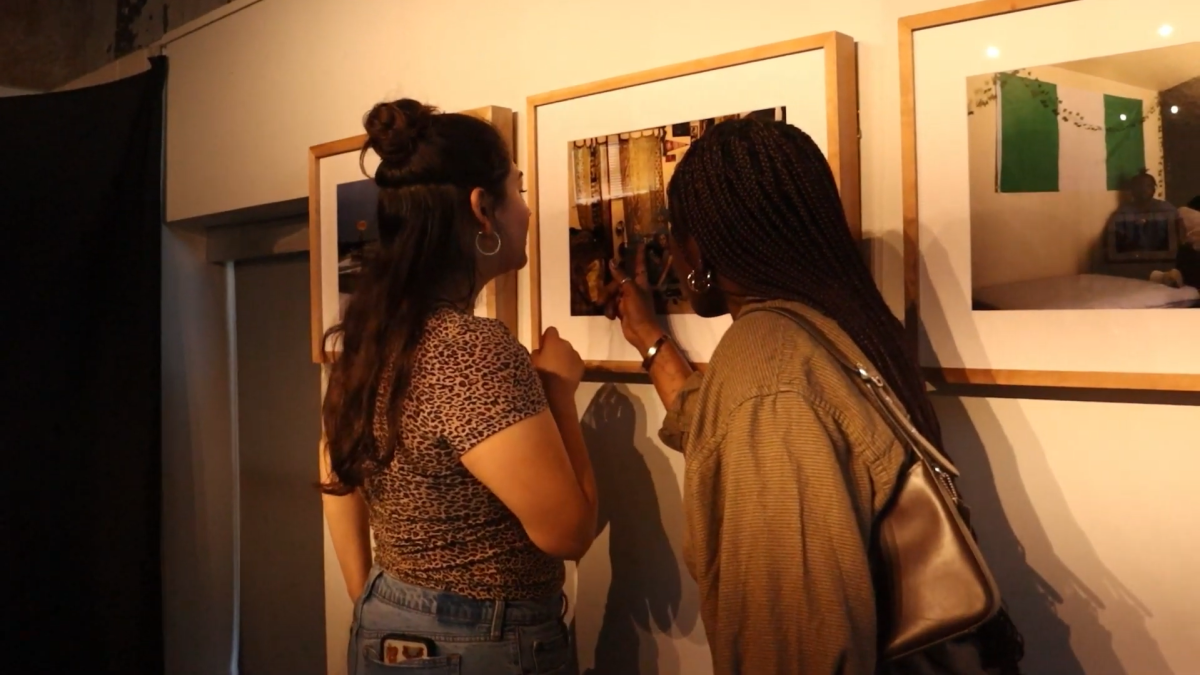












Holocaust awareness group Hate Ends Now visited campus to display World War II artifacts to students on April 23.
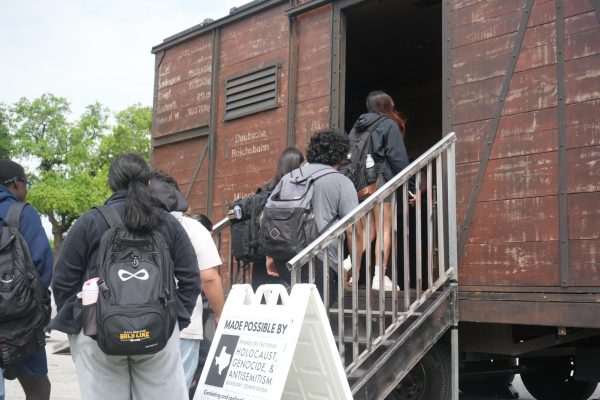
The group was brought to campus by Mothers Against College Antisemitism, a non-profit which combats anti-Jewish bigotry on college campuses. The visited included two exhibits which were open for all students to view. Firstly, a display of artifacts presented by CEO of Hate Ends Now Todd Cohn. Secondly, the Cattle Car Exhibit featured immersive stories from Holocaust survivors screened in a mobile railroad car parked faculty parking lot M.
Assistant Professor of History Alistair Maeer happened to be holding class for his History of World War II course and brought his class to the exhibit.
“Without taking students to a Holocaust museum or to an exhibit you can’t get a sense of the enormity of the atrocity,” Maeer said.
Maeer didn’t know about the exhibition until 8:00 a.m. that morning, but it happened to tie into the debate students had been having in class about properly carrying out justice in response to the war crimes committed during WWII.
“It was a perfect opportunity to allow my students who were debating this very important and tragic moment in history to get a more visceral feel for the gravitas or the seriousness of what had happened during the Holocaust,” Maeer said.
Darrell English is founder of the New England Holocaust Institute and Museum which owns many of the artifacts that were displayed. English spoke about the importance of Holocaust education.
“It’s needed because of current situations and what’s going on around the globe right now,” English said. “We are now 80 years out from these historical events. There are still people living amongst us that have memories of it, but we’re not going to have those people much longer.”
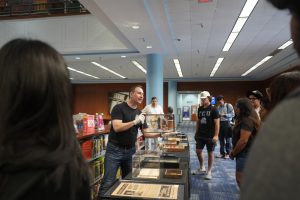
Students viewed artifacts in the library with the CEO of Hate Ends Now, Todd Cohn, and they went into the Cattle Car Exhibit to watch a video narrated by Holocaust survivors.
While the exhibit may no longer be on campus, the impact certainly is, giving students and staff a moment to reflect on the past.
“If we know our story, we know why things are the way they are, and why things could be better, and how they could have been worse,” Maeer said. “That gives us the most powerful thing of all—perspective.”
-
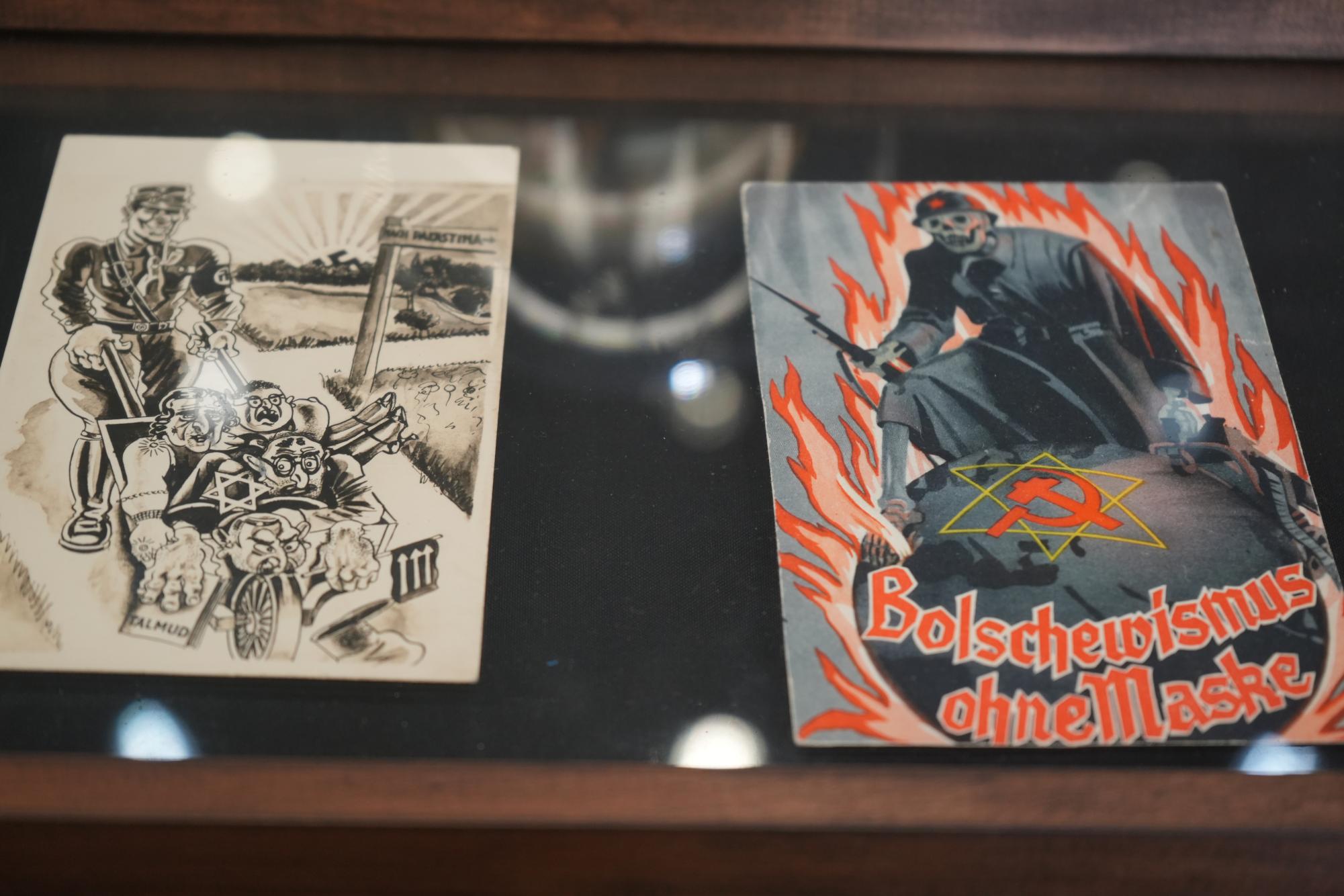
Groups such as the communists and Jewish people were imprisoned by the Nazis. The postcard on the right translates to “Bolshevism unmasked”, the art on the post cards depicts the soviet communist as a death figure of death burning the world alongside the star of David. “Judeo-Bolshevism,” is an Antisemitic conspiracy theory that described communism as a Jewish plot to end Western civilization.
-
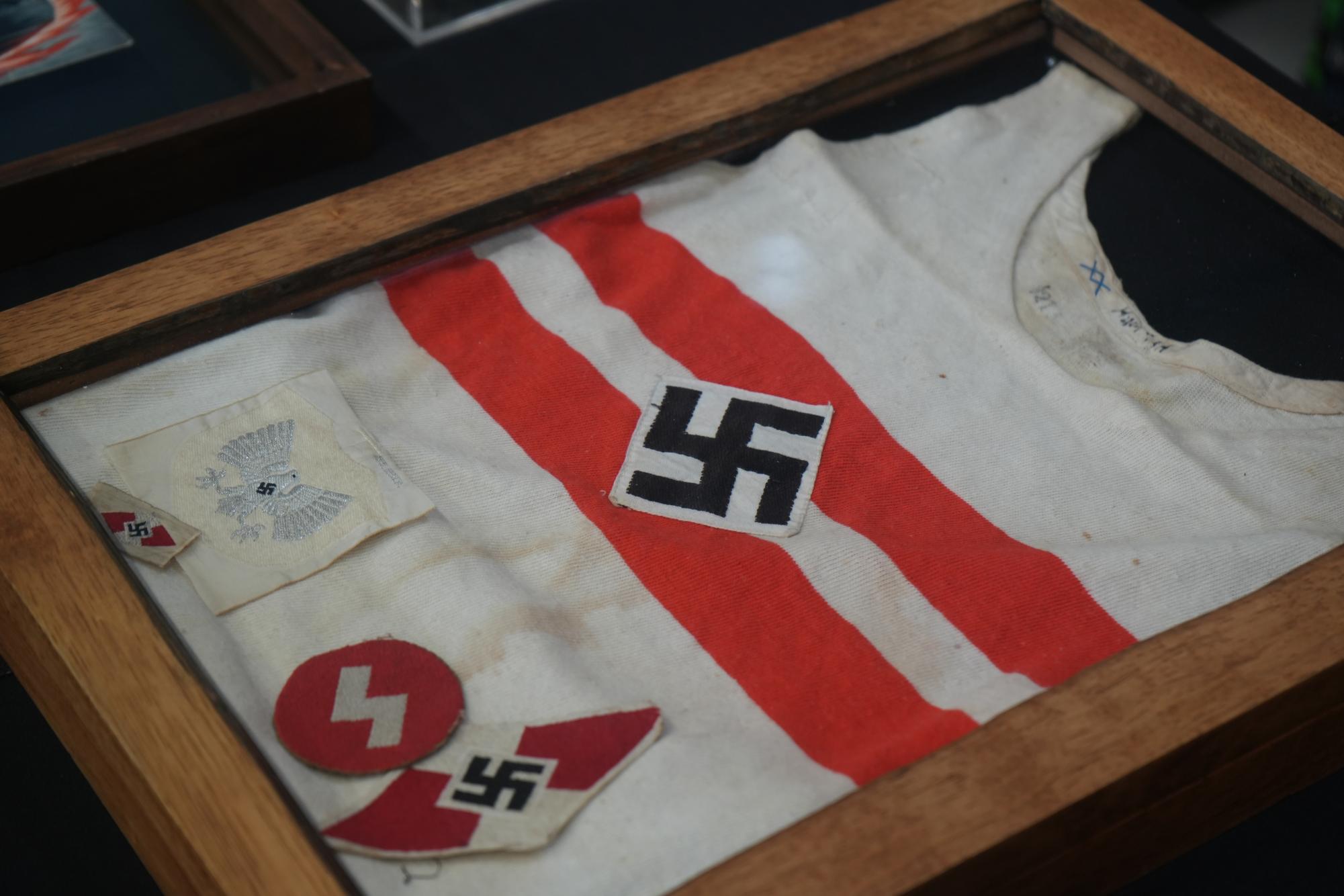
A Nazi sports tank top with two red stripes connected by a diamond swastika was a feature artifact in The English Artifacts Collection. The top was a part of a uniform worn by Hitler Youth sports teams.
-
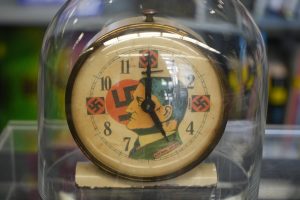
The clock face features four swastikas, a symbol worn by the Nazis, and a profile shot of Adolf Hitler. In 1937, Germans who fled to America because of high inflation, moved to Connecticut where they produced the clock. Propaganda, such as this clock, was sold to promote Adolf Hitler as a powerful leader and show devotion to him.

-
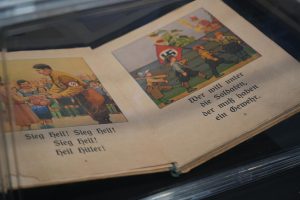
Page four illustrates children accepting flowers from Adolf Hitler with texts that says, “Seig heil,” a popular salute used by the Nazis. On page five, illustrations of children holding weapons and the Nazi Germany flag reside above text that translates to, “Whoever wishes to join the ranks of the soldiers must possess a weapon.” During World War II, propaganda such as children’s books were sold to normalize the Nazi’s regime.

-
Auschwitz Tattooing projects onto students during the cattle cart portion of the exhibit. The incoming prisoner were divided into two groups, selected to work and selected to death. Those selected to work received serial numbers, Auschwitz Tattoos, inked onto the side of their left forearm.

-
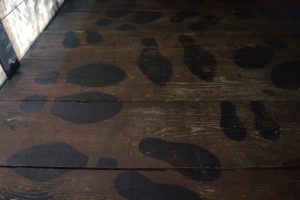
Footprints cover the floor of the cattle cart representing the number of prisoners who were crammed into a single cart at once. Cattle carts were used to send prisoners to concentration camps in Germany.

-
“People can somehow take a look at something like the sports shirt, or the clock, or the shoes, or a document, and visualize and relate with it,” Darrel English founder of the New England Holocaust Institute and Museum, said. “In a book, it’s kind of lifeless because it’s there on the page and you’re looking at it, but you can’t reach, you can’t see it, you can’t hold it.”




Todd Cohn • May 5, 2026 at 10:07 am
Our goal is to help students connect meaningfully with history. The students at Wesleyan were refreshingly curious. They were also comfortable asking hard questions which really reflect on this impressive institution and it’s educators. It was great meeting you Roxanne and Josephine. Thank you for the great coverage.
-Todd Cohn, Hate Ends Now